Ever wonder how to get an accurate temperature reading from your aquarium? Maintaining the right water temperature is key to keeping your fish healthy and happy.
With the right technique and a little know-how, you can ensure your tank stays stable. Keep reading to learn the best way to read your aquarium thermometer and keep your aquatic life thriving.
Why Accurate Water Temperature Matters in Your Aquarium
Maintaining a consistent water temperature between 74 and 78 degrees Fahrenheit is crucial because it directly impacts your fish’s health and behavior. Stable temperatures help regulate their metabolic processes, making it easier for them to digest food and absorb oxygen efficiently. If the water temperature deviates significantly—either too warm or too cold—it can cause stress, weaken their immune system, and increase vulnerability to diseases. Sudden temperature fluctuations can shock your fish or lead to symptoms of hypoxia, such as rapid breathing. Different species require specific temperature ranges for optimal health, so matching those ranges and preventing hot or cold spots in the tank is essential. Regularly monitoring your aquarium’s temperature ensures consistency, allowing your fish to stay active, comfortable, and healthy. Proper aquarium temperature maintenance also helps support healthy plant growth and overall tank stability. Ensuring accurate temperature readings is key to maintaining a stable environment, as faulty thermometers can lead to unnoticed fluctuations that harm your aquatic inhabitants. Additionally, understanding water temperature stability can help you troubleshoot issues more effectively and optimize your tank conditions.
Choosing the Right Aquarium Thermometer: Types and Features
The best aquarium thermometer depends on your specific setup and needs. For direct, reliable readings, placement inside the tank is essential. Glass or floating thermometers sit submerged and provide immediate temperature information. Digital probe thermometers have a sensor placed underwater, connected to an external display, offering quick and highly accurate readings. Stick-on strip thermometers attach to the outside of the glass, making them easy to check but less precise, especially if the external environment changes. Infrared or non-contact thermometers measure surface temperature and are useful for quick checks, but they do not accurately reflect the water’s core temperature. When selecting, prioritize accuracy, ease of reading, durability, and whether the thermometer suits your tank size and configuration. For larger or more complex aquariums, using multiple thermometers can help ensure consistent temperature monitoring** across the entire system. Understanding the different thermometer types and their specific features can significantly improve your tank management. Knowing how appropriate thermometer placement** impacts readings is also crucial for maintaining a stable environment for your fish.

Wide Application: Ideal for use in water or high moisture environment like aquarium terrarium, or vivarium, suitable for different water types such as fresh water, tap water, salty water, marine water and etc.

Wide application: Ideal for use in water or high moisture environment like aquarium terrarium, or vivarium; suitable for different water types such as fresh water, tap water, salty water, marine water and etc.

HD LED Display: PAIZOO Aquarium Thermometer adopts LED screen to display temperature, LED can provide wide viewing angle and the color is saturated, it is easier to read the data no matter day or night. Green environmental protection and energy saving
How to Properly Place Your Thermometer for Precise Readings
To ensure the most accurate temperature readings, place your aquarium thermometer carefully within the tank. Position it on the opposite side of the heater to prevent localized heat distortion. Keep the thermometer at mid-water level, where fish tend to spend most of their time and conditions are more stable. Avoid placement near the surface or substrate, as these areas can have fluctuating temperatures. Opt for a visible location on the front or side of the tank that remains unobstructed and easy to read. Also, steer clear of direct sunlight, vents, and areas with strong water flow, all of which can lead to skewed readings. Match the thermometer type—inside for floating or standing models, outside for stick-on strips—to its placement for the best results. Proper positioning helps maintain a stable environment and accurate temperature measurement for optimal health and behavior.

【Novique Aquarium Temperature Strips】: Are you still guessing the water temperature of your fish tank? Novique Aquarium Temperature Strips will turn guesswork into certainty. With precise temperature sensing technology, the numbers are clear and easy to read. It is convenient to use and widely applicable. Just by looking at the aquarium, you can immediately know the current temperature of the fish's environment, providing a comfortable habitat for the fish.
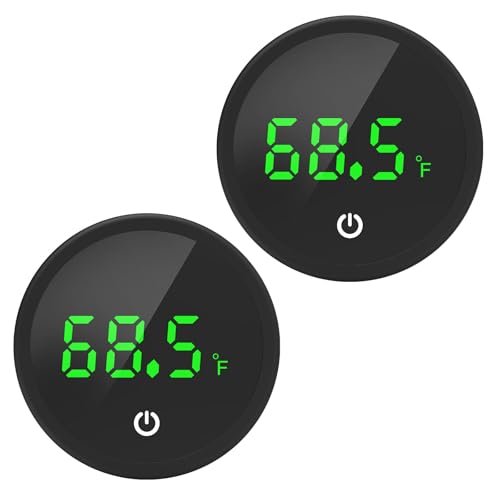
New Digital Aquarium Thermometer: This new fish tank thermometer is equipped with an LED high-definition display and instant ℃/℉ switching (3-second response). It adopts an innovative circular buckle battery replacement design on the back, which takes care of your user experience in various aspects, meets the needs of different groups of people, and is an ideal for fish tank accessories.

Temperature Range: Measure 64°F to 93°F (18°C to 34°C) with accuracy +/- 1°C.
Reading Digital and Glass Thermometers: Tips for Accurate Results
Reading digital and glass thermometers accurately, patience and proper technique are essential. For digital thermometers, wait until the display stabilizes and stops fluctuating—these devices often update in cycles, causing variations of 1 to 2 degrees. To ensure accuracy, take multiple readings over time, especially after moving the probe or making changes to the water tank. Confirm the digital thermometer’s calibration by comparing it with a known accurate device periodically. Using the proper testing techniques can help maintain consistent temperature readings across your aquarium. It’s also helpful to understand thermometer types so you know their specific advantages and limitations when monitoring water temperature. Being aware of sensor performance can further improve the reliability of your readings over time.
For glass thermometers, wait 5 to 10 minutes until the liquid column completely stops moving. Read the temperature at eye level to prevent parallax error, which can give false readings if viewed from an angle. Always compare the reading with a properly calibrated thermometer to maintain accuracy. Both types require patience; rushing through the process can lead to unreliable results. Before recording, confirm the stability of the reading, and periodically recheck to account for fluctuations in water temperature and sensor performance. Proper timing and calibration are crucial for obtaining dependable and precise measurements.

Cordless Design: Built-in an advanced smart microchip, connected with an aluminum alloy sensor to get the latest accurate readings. Suit for use in freshwater and saltwater. The measuring water temperature range is 32°F-140°F, Temperature tolerance is within 0.5°F

1.Accurate Temperature Monitoring: Backside is temperature sensor,press and hold for 3 seconds to switch temperature units.monitoring range from 0℉ to 99℉.Accuracy: ±0.9°F

Aquarium thermometer with a large LCD display that is easy to read clearly, can be switched between °C and °F with the button, real-time monitoring of changes in water temperature
Calibrating Your Aquarium Thermometer for Reliable Measurements
To ensure your aquarium thermometer provides accurate readings, calibrate it using an ice-water bath. Fill a container with crushed ice and a small amount of water—more ice than water helps stabilize the temperature at 32°F (0°C). Place the thermometer in the bath, making sure the sensing tip is fully submerged without touching the container’s sides or bottom. For analog thermometers, immerse the last 2 to 3 inches of the stem; for digital ones, only the probe. Allow the thermometer to sit undisturbed until the reading stabilizes. If your thermometer has a calibration screw, make small adjustments until it reads 32°F (0°C). After calibration, verify the accuracy by checking again at this point, or for higher precision, perform a two-point calibration to ensure consistent measurements across the temperature range.

Application: Great for all home and laboratory TDS & pH testing applications including aquariums, swimming pools

𝗛𝗼𝗺𝗲 𝗔𝗾𝘂𝗮𝗿𝗶𝘂𝗺 𝗪𝗮𝘁𝗲𝗿 𝗧𝗲𝘀𝘁 𝗞𝗶𝘁 - Ensure the health of your fish with aquarium water testing kit & ammonia test strips for fish tank. This complete freshwater & saltwater tank test kit provides a reliable water tester for ammonia, pH, iron, chlorine, total hardness (GH), carbonate, nitrate, nitrite, total alkalinity, copper, and temperature, allowing you to have a complete understanding of your aquarium water quality. Trusted by fish enthusiasts, it adapts to your needs, making it an essential tool for aquarium care.

𝗛𝗢𝗠𝗘 𝗔𝗤𝗨𝗔𝗥𝗜𝗨𝗠 𝗪𝗔𝗧𝗘𝗥 𝗧𝗘𝗦𝗧 𝗞𝗜𝗧 - Ensure the health of your fish with aquarium water test kit. This all-in-one fish tank water test kit provides a reliable water tester for pH, Chlorine, General Hardness, Carbonate Hardness, Nitrate, and Temperature, allowing you to understand your aquarium water quality completely.
Troubleshooting Common Errors and Keeping Your Thermometer Accurate
Even after calibrating your aquarium thermometer, errors can still occur that impact its accuracy. To detect these errors, compare readings with a trusted device or perform calibration tests like the ice bath method—placing the thermometer in a mixture of crushed ice and water to verify it reads around 32°F (0°C). If your digital thermometer consistently shows a 3°F difference—either higher or lower—you can apply a correction factor by adding or subtracting that amount in your records. Some digital models have an internal calibration mode that allows you to adjust the reading directly; check your device’s manual for instructions. For glass thermometers, create a correction chart by recording discrepancies at different temperatures so you can adjust your readings accordingly. Temperature gradients within the tank can skew measurements; place thermometers at various points and note differences over 2°F, which may indicate uneven heating or circulation issues. Always ensure you view the display from a proper angle to avoid parallax errors, and give digital readings a moment to stabilize before recording. Regularly checking for and correcting errors keep your temperature readings reliable and your aquarium healthy. Additionally, materials like alcohol and liquid crystals used in some thermometers can degrade over time, leading to diminished accuracy, so inspecting and replacing them periodically is essential. Proper sensor placement within the tank is crucial for obtaining accurate readings, as it helps minimize measurement errors caused by uneven temperature distribution. Being aware of temperature gradients can further improve measurement reliability, especially in larger aquariums.

Accurately monitor pH and temperature of your fish tank or any type of water with this ph monitor device; PH Measurement Range: 0.0 to 14.0 pH, Accuracy: ±0.1; Resolution: 0.01

Customizable Timer Display: Features both a 24/7 Always-On mode and a Custom Timer mode, allowing for one-touch switching to suit your needs. With adjustable screen brightness for optimal visibility day and night

New digital aquarium thermometer: LED display fish tank thermometer with professional LCD visual effect, the fish tank and aquarium water temperature can be displayed clearly, despite the night light, and can be easily read. Mini compact body design is suitable for a variety of different types of fish tanks and aquariums, is a must have fish tank accessories.
Regular Maintenance for Long-Term Thermometer Performance
Regular maintenance is key to ensuring your aquarium thermometer remains accurate over time. Perform weekly cleaning by gently rinsing the sensor with lukewarm water and wiping it with a lint-free microfiber cloth. Avoid harsh chemicals such as vinegar or alcohol, as these can damage sensitive components. Proper placement also plays a crucial role; position the thermometer in the middle of the tank away from heaters, filters, and direct light sources to prevent localized temperature variations. Ensuring your thermometer is properly calibrated regularly can help maintain accurate readings. Monthly calibration checks are recommended. Use ice-water and boiling-water tests to assess accuracy, and record your results to monitor any drift over time. Daily monitoring at the same times helps detect sudden temperature fluctuations or seasonal changes. During maintenance, verify that the thermometer maintains stable contact with water, adjusting its placement if necessary. Additionally, replace batteries every six months to prevent inaccurate readings, and consider keeping a backup thermometer on hand for added reliability. Being aware of temperature fluctuations in your tank can also help identify issues with heater performance or water quality early on. It’s also beneficial to familiarize yourself with water parameter levels, as fluctuations can sometimes influence water temperature indirectly.